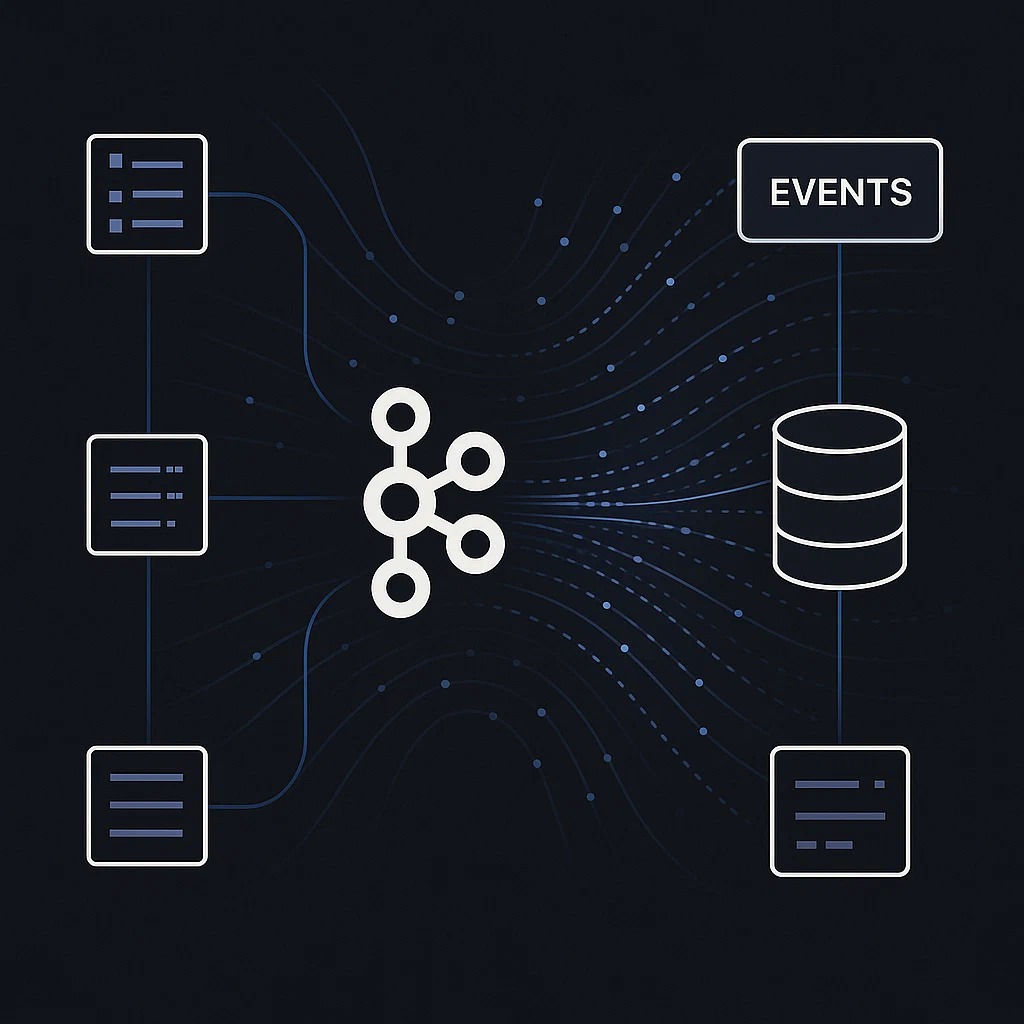
August 2026 update: The synchronous version described below was usable and simpler to operate. Kafka was an exploration of a specific boundary — separating request acceptance from processing and preserving order within each order ID — rather than a prerequisite for “scale”. The current Order Tracking case study documents the narrower guarantees, the operational trade-offs, and the remaining deduplication/replay gaps.
I’d been thinking about how to keep evolving my order-tracking
project. Once the basic functional records were in place, I wanted to explore what changed if ingestion and processing no longer happened in the same synchronous request. Kafka gave me a concrete way to test that boundary: accept work quickly, process it independently, and preserve ordering for events that share an orderId, while accepting the extra operational complexity that comes with a broker.
The problem we were solving
Originally, the service exposed a REST endpoint that synchronously inserted tracking events into the database (one or many per POST). That ties request latency to database work and couples HTTP capacity to processing capacity.
The experiment was to decouple ingestion from processing so the REST layer stays thin and processing can progress independently. The mechanism I chose for that iteration was domain events + Kafka.
Why Redpanda for Kafka?
I wanted the Kafka API without the operational overhead for local/dev and small deployments. Redpanda speaks the Kafka protocol (drop-in compatible with Kafka clients) and ships as a single binary, which makes Docker Compose setups trivial and fast. That let me focus on the app’s design instead of babysitting infra.
Same Kafka clients, simpler ops for local/dev; we can move to managed Kafka later with zero code changes.
The design (DDD/Hexagonal)
At a high level:
  sequenceDiagram
    participant Client
    participant REST as REST API
    participant Domain as Domain Layer
    participant Kafka as Kafka (Redpanda)
    participant Consumer as Tracking Processor
    Client->>REST: POST /order/tracking (batch)
    REST->>Domain: publish(TrackingEvent) x N
    Domain->>Kafka: send to "order-tracking.events" (key = orderId)
    Kafka-->>Consumer: messages (ordered per key)
    Consumer->>Consumer: map to domain
    Consumer->>DB: update timeline + append event
Key ideas:
- Domain emits events, infra publishes them to a private Kafka topic (
order-tracking.events). We use orderId as the key to preserve ordering per order. - A Kafka consumer (with
concurrency = "6") maps the message back to domain and runs the same processing path that previously ran synchronously. - The REST endpoint answers 202 Accepted immediately; the heavy lifting happens asynchronously.
Code walk-through
1) Domain event
// app/src/main/java/com/egobb/orders/domain/event/TrackingEvent.java
public record TrackingEvent(String orderId, Status status, Instant eventTs)
implements DomainEvent {}Simple, immutable, and serializable.
2) Publishing via a domain event handler (infra)
// application port
public interface PublishDomainEventPort {
  void publish(DomainEvent event);
}…and implement it in infrastructure, listening to domain events and publishing to Kafka:
@Component
@RequiredArgsConstructor
public class TrackingEventDomainHandler implements PublishDomainEventPort {
  private final TrackingEventPublisher publisher;

  @Override
  public void publish(DomainEvent event) { this.onDomainEvent(event); }

  @EventListener
  public void onDomainEvent(DomainEvent event) {
    if (event instanceof TrackingEvent ev) {
      final var msg = TrackingEventMapper.toMsg(ev);
		this.publisher.publish(ev.orderId(), msg); // key = orderId
    }
  }
}This keeps domain clean and places Kafka concerns in infrastructure. The key = orderId keeps records for one order on the same partition, which is the ordering boundary used by this design.
3) Message mapping
public class TrackingEventMapper {
  public record TrackingEventMsg(String orderId, String status, Instant eventTs, String schemaVersion) {}
  public static TrackingEventMsg toMsg(TrackingEvent ev) {
    return new TrackingEventMsg(ev.orderId(), ev.status().toString(), ev.eventTs(), "v1");
  }
  public static TrackingEvent toDomain(TrackingEventMsg msg) {
    return new TrackingEvent(msg.orderId(), Status.fromString(msg.status()), msg.eventTs());
  }
}A tiny wire model decoupled from domain and versioned (schemaVersion = "v1").
4) The Kafka producer
@Component
@RequiredArgsConstructor
public class TrackingEventPublisher {
  private final KafkaTemplate<String, TrackingEventMapper.TrackingEventMsg> template;

  public void publish(String key, TrackingEventMapper.TrackingEventMsg msg) {
	  this.template.send(KafkaTopics.TRACKING_EVENTS, key, msg);
  }
}The topic constant:
5) The Kafka consumer
@Slf4j
@Component
@RequiredArgsConstructor
public class TrackingEventListener {
  private final TrackingProcessor processor;

  @KafkaListener(
    topics = KafkaTopics.TRACKING_EVENTS,
    groupId = "order-tracking-processor",
    concurrency = "6")
  public void onMessage(TrackingEventMapper.TrackingEventMsg msg) {
    log.info(">>> Consumed from Kafka: {}", msg);
    final var domain = TrackingEventMapper.toDomain(msg);
	  this.processor.processOne(domain);
  }
}- concurrency = “6” → runs multiple consumers in parallel within the same process.
- The groupId is also aligned in application.yml.
6) The REST endpoint (now asynchronous)
@RestController
@RequestMapping(path = "/order/tracking")
@RequiredArgsConstructor
public class TrackingController {
  private final ProcessTrackingUseCase useCase;

  @PostMapping(consumes = {MediaType.APPLICATION_JSON_VALUE, MediaType.APPLICATION_XML_VALUE})
  public ResponseEntity<Void> ingest(@Valid @RequestBody TrackingEventsDTO body) {
    final var events = body.event().stream().map(this::toDomain).toList();
	  this.useCase.ingestBatch(events);
    return ResponseEntity.accepted().build(); // 202
  }
}Why 202? Because actual processing is asynchronous behind Kafka.
7) Processing logic is unchanged (by design)
public void processOne(TrackingEvent e) {
  final var maybe = repository.findById(e.orderId());
  final var tl = maybe.orElse(new OrderTimeline(e.orderId(), null, null));
  if (!sm.canTransition(tl.lastStatus(), e.status())) return;
  tl.apply(e.status(), e.eventTs());
  repository.save(tl);
  appender.append(e);
}The consumer reuses the exact same domain logic you had before; we only changed how events get there.
Kafka/Redpanda configuration
spring:
  kafka:
    bootstrap-servers: localhost:19092
    producer:
      acks: all
      retries: 10
      properties:
        enable.idempotence: true
      key-serializer: org.apache.kafka.common.serialization.StringSerializer
      value-serializer: org.springframework.kafka.support.serializer.JsonSerializer
    consumer:
      group-id: order-tracking-processor
      auto-offset-reset: latest
      properties:
        isolation.level: read_committed
      key-deserializer: org.apache.kafka.common.serialization.StringDeserializer
      value-deserializer: org.springframework.kafka.support.serializer.JsonDeserializer
    listener:
ack-mode: RECORD- Producer idempotence,
acks=all, and retries reduce producer-side duplicate/retry risk; they do not make the complete business flow exactly-once. read_committedcontrols visibility of transactional records on the consumer side; it is not by itself a replay or deduplication strategy.- Default bootstrap en 19092 (mapeado por Compose).
Redpanda’s Docker Compose quickstarts make exposing a single broker + Console straightforward; this project uses that style of layout for local dev
Running it locally
- Start infra:
make up # boots Postgres + Adminer + Redpanda (Kafka API)- POST a batch:
curl -X POST http://localhost:8080/order/tracking   -H 'Content-Type: application/json'   -d '{
        "event": [
          {"orderId":"A-1","status":"PLACED","eventTs":"2025-09-22T08:00:00Z"},
          {"orderId":"A-1","status":"SHIPPED","eventTs":"2025-09-22T10:00:00Z"},
          {"orderId":"B-7","status":"PLACED","eventTs":"2025-09-22T09:00:00Z"}
        ]
}'- Watch the consumer logs and inspect the DB/Adminer.
(Tip: Document in your README the Redpanda Console URL if you expose it in Compose.)
Integration testing
- The project includes Testcontainers Kafka dependency and integration tests (OrderTrackingIntegrationTest, RestIntegrationTest). These validate that a POST triggers a domain event, the event is published/consumed, and the timeline & event append are persisted.
What to test (ideas):
- Ordering per key: two events for the same orderId should be processed in order.
- At-least-once processing: duplicate deliveries don’t corrupt the timeline (consider idempotency constraints).
- Versioning: messages with schemaVersion=“v1” still map cleanly; unknown versions go to DLT.
Why the domain event handler pattern?
- Separation of concerns: HTTP → Application → Domain emits intent. Infra decides how that intent is transported.
- Testability: Domain remains POJO/record-centric; transport is mocked in unit tests and exercised in integration tests.
- Evolvability: Adding DLT, retry, observability, or switching brokers stays in infra.
Why a private Kafka topic?
- It’s an internal contract. We can evolve schema/versioning without breaking external consumers.
- Using key = orderId keeps records for one order within the same Kafka ordering boundary. It does not provide global ordering or prove end-to-end exactly-once processing.
Next steps
Historical note: This is the exploration backlog I had in September 2025, preserved as part of the article. It is not the current project roadmap; the case study tracks the evidence-driven gaps that matter now.
- Dead-letter topic (DLT) and retry/backoff policy.
- Functional metrics at invalid state transitions.
- Idempotency at DB level.
- More partitions + consumer autoscaling.
- CQRS with Command pattern.
- Event contracts API-first.
- Schema Registry for moving to Avro.